Every November, classrooms fill up with paper turkeys, each feather labeled with something a student is thankful for. It’s a sweet tradition, and it undersells the idea badly. Gratitude isn’t just a seasonal craft. It’s one of the better-studied practices in positive psychology, with research conducted in real schools showing real effects on how students feel about their classes, their classmates, and their lives. The turkey comes down in December. The practice deserves to stay.
What the research actually says
Psychologist Jeffrey Froh has spent much of his career studying gratitude in young people, and the findings are encouraging. In a program described by the Greater Good Science Center at UC Berkeley, students ages 8 to 11 received a week of daily half-hour lessons in grateful thinking. The students showed significant gains in grateful thinking and grateful mood, and when their school later invited kids to write thank-you notes to the PTA, the students who’d had the lessons wrote 80 percent more notes than students who hadn’t. A second version of the program, taught in five weekly lessons, produced group differences that were largest five months later. Gratitude, it turns out, keeps growing after you plant it.
The broader picture points the same way. The Greater Good Science Center’s Gratitude in Education initiative notes that hundreds of studies over the past fifteen years have linked gratitude to greater happiness, stronger relationships, and better physical health, and that studies with young people suggest it fosters more positive emotions and better attitudes toward school. None of this makes gratitude a magic wand. It makes it a cheap, pleasant practice with an actual evidence base, which is more than you can say for most things that take two minutes of class time.
Start small: the gratitude bell ringer
The easiest entry point is a routine you already run. Once a week, make your opener a gratitude prompt: write down one specific thing from the past week you’re thankful for, and one sentence about why. The specificity matters. “My family” is a fine answer that teaches nothing; “my brother quizzed me for the science test even though his show was on” is a small act of noticing, and noticing is the skill you’re building. If your openers need a refresh anyway, there are more ideas in our guide to bell ringers that get students focused from minute one.
The journal that adds up to a thousand
Writing on Edutopia, teacher Owen Griffith describes starting every day with students writing five gratitudes in a composition book. By the end of the year, each student has written nearly a thousand. Once a week, the class shares favorites out loud. His advice matches the research: push students past generic answers toward specific ones, and challenge them to find something to appreciate even in homework and chores. You don’t need five a day to get the benefit, either. Two or three, a few times a week, sustained all year, beats a burst of ten in November that dies by December.
Make gratitude visible (and occasionally loud)
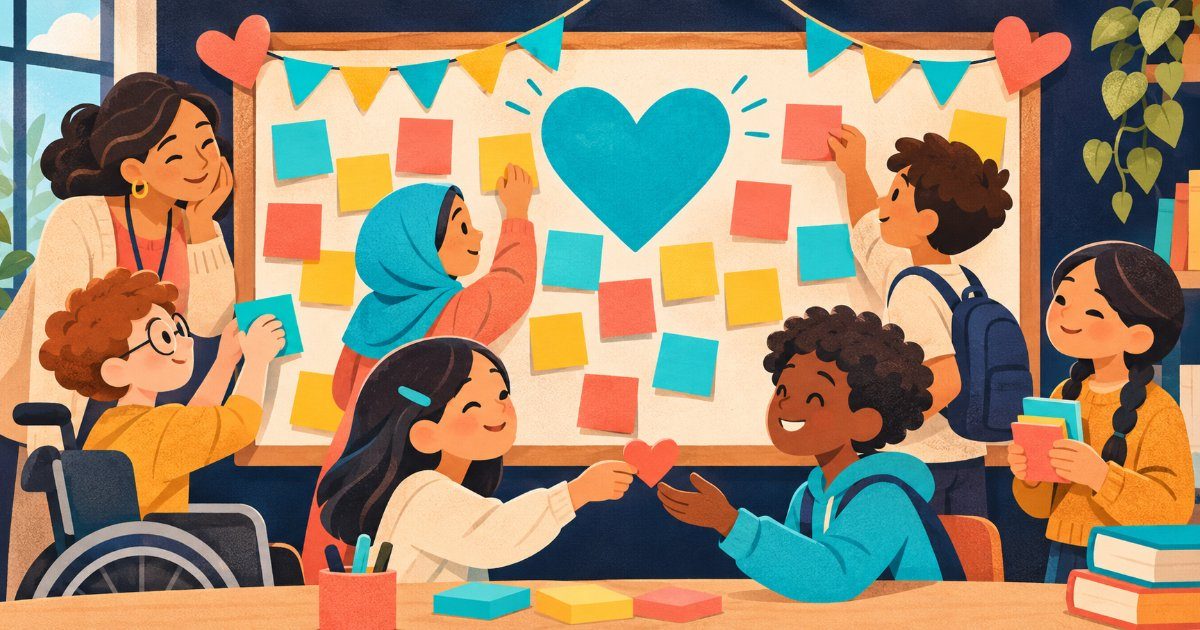
Gratitude grows when it circulates. Griffith posts student gratitudes on sticky notes on the classroom door, where every entrance and exit becomes a tiny reminder. A digital spin on the same idea: run an anonymous word cloud asking students for one word that captures something they’re grateful for this week, and watch the screen fill in real time. The anonymity lowers the stakes for self-conscious students, and the collective picture tells the class something about itself. If you haven’t tried the format, here’s how live polls and word clouds can carry a discussion like this one.
Thank-you notes deserve a revival too. Froh’s students wrote them to the PTA, but the targets are everywhere: the custodian, the office staff, last year’s teacher, a classmate who helped. Ten minutes, paper, and a pen. Few activities deliver more warmth per minute of class time.
Teach the thinking, not just the thanking
Part of what made Froh’s lessons work is that they taught students how to appraise a kind act: someone chose to help you on purpose, it cost them something to do it, and you got a real benefit from it. Those three questions turn gratitude from a reflex into a way of reading the world. They also make excellent discussion prompts. Ask students to describe a time someone helped them, then unpack it together. What did it cost that person? Did they have to do it? What changed for you? Discussions like this give quieter students a structured way in, and they tend to surface stories that change how classmates see each other.
Keep it going past the turkey
The five-month finding is the one worth remembering: in Froh’s program, the benefits were largest long after the lessons ended. That argues for treating gratitude as a routine, not a unit. A weekly gratitude bell ringer. An occasional word cloud. Thank-you notes once a grading period. Maybe an exit ticket now and then asking students to name one thing from today’s class they appreciated. None of it costs more than a few minutes. November is a natural time to start because the season hands you the excuse. The reason to continue is that it works, quietly, for months after anyone remembers whose idea it was.